
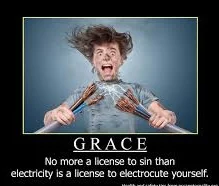
GRACE - A LICENCE TO SIN?
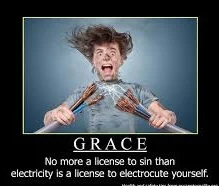
Question: Why, O why, do you who oppose Jesus' grace claim that preaching grace is a license to sin when the scriptures teach the exact opposite?Rom 6:14 Sin shall not be your master, because you are not under law, but under grace. What then? Shall we sin because we are not under law but under grace? By no means!

CARNAL LOGIC
1Co 2:14 The person without the Spirit does not accept the things that come from the Spirit of God but considers them foolishness, and cannot understand them because they are discerned only through the Spirit. It’s because Jesus’ grace is offensive to carnal, soulish, thinking (1Co.1:12-16) and can only be accepted in one's spirit by the Spirit. God's grace always offends and confuses all who ultimately exalt carnal knowledge and logic above Spirit revealed, scriptural, truth. There is no worldly logic in God's grace. No logic in the fact that God himself died for Sin and freely pardons ALL our sins. This is because it's God's heavenly wisdom, thinking and His ways are simply not man's ways. God's way of Grace offends the flesh and fleshy thinking but exalts the Spirit within that reveals the deep truths found in Christ alone and confirmed by the scriptures.

SIN IS BAD AND DESTRUCTIVE
Rom 6:1 What shall we say, then? Shall we go on sinning so that grace may increase? By no means! We are those who have died to sin; how can we live in it any longer? Please hear me everyone... Sin is evil, destructive and harms us all. No one is sayings sin is good and no one is handing out licenses to sin. Anyone claiming that teachers of Jesus' Grace are saying sin is OK and sin doesn't matter, are simply confused or at worst, lying. What we are saying that sin isn't our focus and obsession anymore -Jesus is.

ANTI-LAW? – NO!
Rom 3:20 No one will be declared righteous in God's sight by the works of the law; rather, through the law we become conscious of our sin..... Rom 5:20 The law was brought in so that sin might increase. But where sin increased, grace increased all the more. Are we anti the law. In no way! We are not anti the Law, we uphold the Law as the Law is good and powerful when used for its correct purpose. i.e. To emphasis and expose sin, especially the sin of self righteousness, and lead Sinners and Pharisees to Jesus and His Grace. We are anti the misuse of the Law which harms and condemns believers. At the moment the Law is being misused by many, as a means of bulling and controlling believers, as a tool for maintaining justification and sanctification and for instilling fear into believer’s lives – all of which is error.

GRACE IS GOD’S SOLUTION FOR SIN
Tit 2:12 Grace teaches us to say "No" to ungodliness and worldly passions, and to live self-controlled, upright and godly lives in this present age.... Rom 6:14 Sin shall not be your master, because you are not under law, but under grace. In some Christian circles, grace has become a swear word. But despite all this opposition to grace, let's be clear - whether you like it or not, the Bible teaches that God's solution for sin is His Grace released through the cross. Not our moralizing, not our ranting again sin, not our legalizing, not self righteousness, not our own logic and strength and not our denial of God's grace - its Jesus' grace alone that has dealt with Sin and empowers us to live righteous lives.

WORKS RELIGION
Heb 9:14 How much more shall the blood of Christ, who through the eternal Spirit offered himself without spot to God, purge your conscience from dead works to serve the living God? It may be that those who won't fully accept the gospel of God's Grace needs go elsewhere with their law gospel. There's a Mosque or an Orthodox Synagogue near you and the self righteous feel very comfortable there - living by laws, rules and regulations. I believe they are looking for good law preachers....but seriously brothers, don't abandoned the Gospel of Grace, God needs us to share the Good News, not the bad news of Law, works and condemnation.

A LICENSE OF FREEDOM
2Co 3:15 Even to this day when Moses is read (i.e. The Law), a veil covers their hearts. But whenever anyone turns to the Lord, the veil is taken away. Now the Lord is the Spirit, and where the Spirit of the Lord is, there is freedom. I know freedom scares law preachers, because at the end of the day they don't believe the Word in the New Testament scriptures or the Holy Spirit’s ability within believers to do the work of holiness. They believe more in the power of sin than the power of the Cross. But where the Spirit of The Lord is there is freedom. In Christ, we preach HIS gospel of Grace and Kingdom (Acts 20:24) and we handout licenses of freedom from sin. The bold print is clear: We are forgiven and have freedom from the slavery to both sin and death. We are now citizens of a new Kingdom, with a new King - and by His Spirit we live.

NO SMALL PRINT
On a Grace License, signed with the blood of Jesus, there’s no hidden, horrible, legal conditions written in small print, so we are not afraid of being deceived or dragged off to court again. The conditions are clear, we are free, forgiven and now under Jesus’ grace and beloved children of the Father.
Finally, let's proclaim the good news; "Sin is no longer my master, because I'm under Jesus' grace". The question is for all of us: "Is sin still my master?" If so turn away from your dead works and unbelief, be humble, repent and accept Jesus' free gift of Grace and forgiveness today.
Be blessed and loved. http://gracelovetruth.com/?p=925
TEST FOR GRACE
 HOW DO YOU KNOW IF SOMETHING IS GRACE OR LAW?
We need to live in Jesus' grace by the leading of the Holy Spirit. It's important that we, God's people, free ourselves from the ministry of the Law (i) because the Bible teaches that the Law brings condemnation and death (ii) - these manifest in passivity, depression and sickness (iii). Sadly brothers and sisters many believes are experiencing this horrible fruit of the Law, often convinced that it's God punishing them or training them.
Because most of us have grown up with a mixture of grace and religious law, many find it hard to distinguish whether what they are hearing or thinking is rooted in grace or Law. One can't generalize but over the years I have found that Believers can test by asking the following questions. This simple test that will normally expose if the root is Law or Grace.
1. If it points to Jesus and what He has done for us on the cross - it's normally grace. If it points to you and what you should be doing for God - its normally Law.
2. If the fruit in you is condemnation or guilt - it's Law. If the fruit in you is freedom - it's grace
3. If it's about God's judgment and punishment - it's Law. If it's about God' love and forgiveness - it's grace.
4. If it harps on about your sinfulness - it's Law. If it focuses on your Christ given righteousness - it's grace.
5. If it's about, techniques, methods and principles - it's Law. If it's about hearing and being lead by the Holy Spirit - it's grace.
6. If it restricts or discourages you form sharing and ministering - it's Law. If it encourages and releases you to share and minister - it's grace.
7. If it causes you to judge others - it's Law. If it causes you to see the God given potential in others - it's grace.
8. If it from the Old Testament without pointing to Jesus or the New Covenant - it's Law If it reveals Jesus and the good news of His New Covenant - it's grace.
9. If it accuses you, like Satan the accuser,- it's Law If it affirms you - it's grace
10. If it's focus is on you being God's servant or slave - it's Law If it declares you to be a beloved child of The Father, who is about the Fathers work - it's grace.
11. If it's about your performance - it's Law. If it's about resting in Christ - it's grace
12. If it's focus is you obeying - it's Law. If it's about Jesus' obedience - it's grace.
13. If it declares you cursed - it's Law. If it declares you blessed - it's grace.
14. If the focus on what you sow - it's Law. If the focus is on what Jesus has sown on the cross - it's grace.
15. If it causes to to fear and run away from God - it's Law. If it stirs up faith and intimacy with God - it's grace.
There are many more that I'm sure you can think of, let me know. Be wise and be discerning, test all things, including this.
Blessing and love to you in Christ.
-------------------------------------------------------------------------------------------------------------------
THE SCRIPTURAL REFERENCES
(i) Gal 3:1 You foolish Galatians! Who has bewitched you? Before your very eyes Jesus Christ was clearly portrayed as crucified. I would like to learn just one thing from you: Did you receive the Spirit by observing the law, or by believing what you heard? Are you so foolish? After beginning with the Spirit, are you now trying to attain your goal by human effort? (ii)Deu 28:15 However, if you do not obey the LORD your God and do not carefully follow all his commands and decrees (The Law) that I, Moses, am giving you today, all these curses will come upon you and overtake you........ (iii) 2Co 3:7 Now if the ministry that brought death, which was engraved in letters on stone, came with glory, so that the Israelites could not look steadily at the face of Moses because of its glory, fading though it was, will not the ministry of the Spirit be even more glorious? If the ministry that condemns men is glorious, how much more glorious is the ministry that brings righteousness!

WHAT IS LEGALISM

Legalism, in Christian theology, is a usually pejorative term referring to an over-emphasis on discipline of conduct, or legal ideas, usually implying an allegation of misguided rigour, pride, superficiality, the neglect of mercy, and ignorance of the grace of God or emphasizing the letter of law at the expense of the spirit. Legalism is alleged against any view that obedience to law, not faith in God’s grace, is the pre-eminent principle of redemption.
In the New Testament
The words ‘legalism’ or ‘legalist’ do not occur in the Old or New Testaments. Legalism’s root word, “law” (Greek nomos), occurs frequently in the New Testament, and sometimes connotes legalism. The Greek of Paul’s day lacked any term corresponding to the distinct position of “legalism”, “legalist”, or “legalistic”,
One concept of legalism, the belief that salvation can be earned by obedience to laws, is referred to in various New Testament books, including Galatians. In this case, some Jews who had become Christians believed that in order to obtain salvation, both faith in Christ (as Messiah), and obedience to the Mosiac laws were required, such as the cases of the circumcision controversy and the Incident at Antioch. Generally, however, these cases are referred to as the Judaizer controversy, rather than a legalism controversy, but the two are related.
Legalism refers to any doctrine which states salvation comes strictly from adherence to the law. It can be thought of as a works-based religion. Groups in the New Testament said to be falling into this category include the Pharisees, Sadducees, Scribes, Judaizers, and Nicolaitans. They are legalists because they emphasized obeying the Law of Moses, in the case of the Pharisees and Scribes, to the letter without understanding the concept of grace. Jesus condemned their legalism in Matthew 23. The Pharisees love of the praises of men for their strict adherence is said to be a prime example of legalism.
Legalism is sometimes confused with obedience. New Testament books such as Romans, speak of grace and obedience together. An example is found in Romans 1:5 (New American Standard Version) speaking of Christ ‘through whom we have received grace and apostleship to bring about the obedience of faith among all the Gentiles, for His name’s sake…’ The goal of receiving the grace was to bring about obedience of faith. Here grace, faith and obedience are tied together. Other references are in Acts 5:29, 32; Romans 16:19; 2 Corinthians 7:15; Hebrews 5:9.
Legalism is also confused with discipline, which is often spoken of in a positive light. See 1 Corinthians 9:17; 1 Timothy 4:7; 2 Timothy 1:7 and Hebrews 12:5–11.
A third common misunderstanding of legalism is the word law. Law in many places in the Bible refers to the Law of Moses, see also Biblical law in Christianity. In Galatians the Judaizers were trying to insist that salvation required that a person be circumcised prior to obeying the Law of Christ. Galatians 2:16 says, “Knowing that a man is not justified by the works of the law, but by the faith of Jesus Christ, even we have believed in Jesus Christ, that we might be justified by the faith of Christ, and not by the works of the law: for by the works of the law shall no flesh be justified” (King James Version). The faith here is the Law of Christ and the law here is the Law of Moses. The legalism of the Judaizers was that obedience to the law of Moses was necessary to be saved