
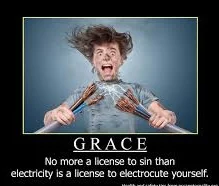
GRACE - A LICENCE TO SIN?
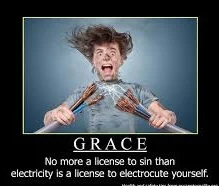
Question: Why, O why, do you who oppose Jesus' grace claim that preaching grace is a license to sin when the scriptures teach the exact opposite?Rom 6:14 Sin shall not be your master, because you are not under law, but under grace. What then? Shall we sin because we are not under law but under grace? By no means!

CARNAL LOGIC
1Co 2:14 The person without the Spirit does not accept the things that come from the Spirit of God but considers them foolishness, and cannot understand them because they are discerned only through the Spirit. It’s because Jesus’ grace is offensive to carnal, soulish, thinking (1Co.1:12-16) and can only be accepted in one's spirit by the Spirit. God's grace always offends and confuses all who ultimately exalt carnal knowledge and logic above Spirit revealed, scriptural, truth. There is no worldly logic in God's grace. No logic in the fact that God himself died for Sin and freely pardons ALL our sins. This is because it's God's heavenly wisdom, thinking and His ways are simply not man's ways. God's way of Grace offends the flesh and fleshy thinking but exalts the Spirit within that reveals the deep truths found in Christ alone and confirmed by the scriptures.

SIN IS BAD AND DESTRUCTIVE
Rom 6:1 What shall we say, then? Shall we go on sinning so that grace may increase? By no means! We are those who have died to sin; how can we live in it any longer? Please hear me everyone... Sin is evil, destructive and harms us all. No one is sayings sin is good and no one is handing out licenses to sin. Anyone claiming that teachers of Jesus' Grace are saying sin is OK and sin doesn't matter, are simply confused or at worst, lying. What we are saying that sin isn't our focus and obsession anymore -Jesus is.

ANTI-LAW? – NO!
Rom 3:20 No one will be declared righteous in God's sight by the works of the law; rather, through the law we become conscious of our sin..... Rom 5:20 The law was brought in so that sin might increase. But where sin increased, grace increased all the more. Are we anti the law. In no way! We are not anti the Law, we uphold the Law as the Law is good and powerful when used for its correct purpose. i.e. To emphasis and expose sin, especially the sin of self righteousness, and lead Sinners and Pharisees to Jesus and His Grace. We are anti the misuse of the Law which harms and condemns believers. At the moment the Law is being misused by many, as a means of bulling and controlling believers, as a tool for maintaining justification and sanctification and for instilling fear into believer’s lives – all of which is error.

GRACE IS GOD’S SOLUTION FOR SIN
Tit 2:12 Grace teaches us to say "No" to ungodliness and worldly passions, and to live self-controlled, upright and godly lives in this present age.... Rom 6:14 Sin shall not be your master, because you are not under law, but under grace. In some Christian circles, grace has become a swear word. But despite all this opposition to grace, let's be clear - whether you like it or not, the Bible teaches that God's solution for sin is His Grace released through the cross. Not our moralizing, not our ranting again sin, not our legalizing, not self righteousness, not our own logic and strength and not our denial of God's grace - its Jesus' grace alone that has dealt with Sin and empowers us to live righteous lives.

WORKS RELIGION
Heb 9:14 How much more shall the blood of Christ, who through the eternal Spirit offered himself without spot to God, purge your conscience from dead works to serve the living God? It may be that those who won't fully accept the gospel of God's Grace needs go elsewhere with their law gospel. There's a Mosque or an Orthodox Synagogue near you and the self righteous feel very comfortable there - living by laws, rules and regulations. I believe they are looking for good law preachers....but seriously brothers, don't abandoned the Gospel of Grace, God needs us to share the Good News, not the bad news of Law, works and condemnation.

A LICENSE OF FREEDOM
2Co 3:15 Even to this day when Moses is read (i.e. The Law), a veil covers their hearts. But whenever anyone turns to the Lord, the veil is taken away. Now the Lord is the Spirit, and where the Spirit of the Lord is, there is freedom. I know freedom scares law preachers, because at the end of the day they don't believe the Word in the New Testament scriptures or the Holy Spirit’s ability within believers to do the work of holiness. They believe more in the power of sin than the power of the Cross. But where the Spirit of The Lord is there is freedom. In Christ, we preach HIS gospel of Grace and Kingdom (Acts 20:24) and we handout licenses of freedom from sin. The bold print is clear: We are forgiven and have freedom from the slavery to both sin and death. We are now citizens of a new Kingdom, with a new King - and by His Spirit we live.

NO SMALL PRINT
On a Grace License, signed with the blood of Jesus, there’s no hidden, horrible, legal conditions written in small print, so we are not afraid of being deceived or dragged off to court again. The conditions are clear, we are free, forgiven and now under Jesus’ grace and beloved children of the Father.
Finally, let's proclaim the good news; "Sin is no longer my master, because I'm under Jesus' grace". The question is for all of us: "Is sin still my master?" If so turn away from your dead works and unbelief, be humble, repent and accept Jesus' free gift of Grace and forgiveness today.
Be blessed and loved. http://gracelovetruth.com/?p=925
TEST FOR GRACE
 HOW DO YOU KNOW IF SOMETHING IS GRACE OR LAW?
We need to live in Jesus' grace by the leading of the Holy Spirit. It's important that we, God's people, free ourselves from the ministry of the Law (i) because the Bible teaches that the Law brings condemnation and death (ii) - these manifest in passivity, depression and sickness (iii). Sadly brothers and sisters many believes are experiencing this horrible fruit of the Law, often convinced that it's God punishing them or training them.
Because most of us have grown up with a mixture of grace and religious law, many find it hard to distinguish whether what they are hearing or thinking is rooted in grace or Law. One can't generalize but over the years I have found that Believers can test by asking the following questions. This simple test that will normally expose if the root is Law or Grace.
1. If it points to Jesus and what He has done for us on the cross - it's normally grace. If it points to you and what you should be doing for God - its normally Law.
2. If the fruit in you is condemnation or guilt - it's Law. If the fruit in you is freedom - it's grace
3. If it's about God's judgment and punishment - it's Law. If it's about God' love and forgiveness - it's grace.
4. If it harps on about your sinfulness - it's Law. If it focuses on your Christ given righteousness - it's grace.
5. If it's about, techniques, methods and principles - it's Law. If it's about hearing and being lead by the Holy Spirit - it's grace.
6. If it restricts or discourages you form sharing and ministering - it's Law. If it encourages and releases you to share and minister - it's grace.
7. If it causes you to judge others - it's Law. If it causes you to see the God given potential in others - it's grace.
8. If it from the Old Testament without pointing to Jesus or the New Covenant - it's Law If it reveals Jesus and the good news of His New Covenant - it's grace.
9. If it accuses you, like Satan the accuser,- it's Law If it affirms you - it's grace
10. If it's focus is on you being God's servant or slave - it's Law If it declares you to be a beloved child of The Father, who is about the Fathers work - it's grace.
11. If it's about your performance - it's Law. If it's about resting in Christ - it's grace
12. If it's focus is you obeying - it's Law. If it's about Jesus' obedience - it's grace.
13. If it declares you cursed - it's Law. If it declares you blessed - it's grace.
14. If the focus on what you sow - it's Law. If the focus is on what Jesus has sown on the cross - it's grace.
15. If it causes to to fear and run away from God - it's Law. If it stirs up faith and intimacy with God - it's grace.
There are many more that I'm sure you can think of, let me know. Be wise and be discerning, test all things, including this.
Blessing and love to you in Christ.
-------------------------------------------------------------------------------------------------------------------
THE SCRIPTURAL REFERENCES
(i) Gal 3:1 You foolish Galatians! Who has bewitched you? Before your very eyes Jesus Christ was clearly portrayed as crucified. I would like to learn just one thing from you: Did you receive the Spirit by observing the law, or by believing what you heard? Are you so foolish? After beginning with the Spirit, are you now trying to attain your goal by human effort? (ii)Deu 28:15 However, if you do not obey the LORD your God and do not carefully follow all his commands and decrees (The Law) that I, Moses, am giving you today, all these curses will come upon you and overtake you........ (iii) 2Co 3:7 Now if the ministry that brought death, which was engraved in letters on stone, came with glory, so that the Israelites could not look steadily at the face of Moses because of its glory, fading though it was, will not the ministry of the Spirit be even more glorious? If the ministry that condemns men is glorious, how much more glorious is the ministry that brings righteousness!
GRACE 3: MIXING GRACE & LAW

THERE IS REALLY GOOD NEWS
The Holy Spirit is bringing us back to the foundations of The New Covenant:
1) Grace = God’s Unmerited Favor, Love and Blessing. 2) Our Righteousness in Christ = Our Right Standing with a good and loving God. 3) That Righteousness by faith is the key to understanding grace. 4) The finished and all sufficient work of the cross of Jesus Christ. 5) Our focus on our Righteousness (in Christ) instead of on our Sin.
MIXING LAW & GRACE Many of us, without realizing it have been living our Christian lives by a mixture of grace and Old Testament Law. We have been trapped to a lesser or greater degree, in a cycle of self effort, perfectionism, unworthiness, condemnation, sin, guilt and sickness. To break these cycle we have more often than not resorted to imposing more religious laws, rules, demands and conditions on ourselves. All requiring even more self effort. After decades of trying to live this way many of us have become worn out, sick and joyless – it’s simply all too much for us.
There are two reasons why it is crucial that this issue be confronted: 1) This mixture is killing Christians and driving them to sin! 2) This mixture denies the effectiveness of the work of the cross and dishonors Jesus.
LAW PRODUCES DEATH Paul’s teachings, especially in Romans and Galatians, makes it clear that we are not called to live by the Law or by a mixture of Law and grace. This mixture is in fact the main theme of most of Paul’s writings. He was constantly trying to deal with those Christians and non-believers in the Church who denied the sufficiency of grace and wanted to live and maintain their right standing with God (Righteousness) by keeping the ten commandments and other religious laws.
Paul teaches that trying to keep the Law produces condemnation, sickness and death. The Law is not there for us to live by but it is there to expose the sin of the unsaved and to emphasis their need for a savior. (I am happy to go through this scripture by scripture if anyone would like).
BUT JESUS PREACHED THE LAW The problem is that when we look at the scriptures in the traditional way it appears that there is a lot of performance demands and law keeping placed on us, the New Covenant believer. Jesus clearly taught the keeping of the law, however it was in a specific context to those seeking to be justified (made righteous) by the keeping of the law, the self-righteous Jews. It is crucial that we read Jesus teaching in context and understand to whom the teachings were addresses otherwise we will bring ourselves under the Law.
READING SCRIPTURE IN CONTEXT As New Covenant believers, when interpreting any scripture we must be seek to answer the following questions: 1) What is the context of the scripture 2) Who is speaking. ii) Who is he speaking to. iii) What issue was being addressed. 3) Is this teaching the Old Covenant or the New Covenant. 4) What Covenant are the people under who the teaching is addressed to. 5) How does this point to, or reveal, Jesus and His Kingdom. 6) How does this point to, or reveal, the cross and grace. 7) Does it expose self-righteous religiosity or righteousness by faith.
LAW OR GRACE TINTED GLASSES If we realize that we have incorrectly mixed law and grace and have also taken scripture out of context, we will understand that this has affected the way we have interpreted scripture. When we choose to believe in grace we can re-examine the scriptures in their true context and from a position of pure grace. You will find that this will be an amazing journey and reveal glorious good news in Christ. For many it is like reading the Bible for the first time! Discovering the Grace and Righteousness that is ours in Christ, our freedom from law keeping and self effort restores your joy and zeal for the “gospel, the good news”. Try it, ask the Holy Spirit to show you the difference between legalistic, mixed Christianity and Grace filled, Christ centered, Christianity. A good example to start with is:
THE PARABLE OF THE GOOD SAMARITAN (REVISITED IN GRACE) Luk 10:25 On one occasion an expert in the law stood up to test Jesus. “Teacher,” he asked, “what must I do to inherit eternal life?”26 “What is written in the Law?” he replied. “How do you read it?”27 He answered: “‘Love the Lord your God with all your heart and with all your soul and with all your strength and with all your mind’; and, ‘Love your neighbor as yourself.’” 28 “You have answered correctly,” Jesus replied. “Do this and you will live.”29 But he wanted to justify himself, so he asked Jesus, “And who is my neighbor?”……..
THE TRADITIONAL INTERPRETATION The story of the Good Samaritan is probably one of Jesus’ best known parables. We all learnt it as kids and were encouraged to be just like the good Samaritan. He was the epitome of the way a good Christian should live. We were constantly told a good Christians must “Love their neighbor”. This, it is said is the purpose of the parable. However, this generally accepted interpretation of this parable is a self- righteous law orientated view which has lead to huge condemnation and guilt among Christians, who in the majority of instances have found it difficult and actually impossible to fulfill in practice.
THE GRACE INTERPRETATION You will be surprised to hear that the noble and worthy sentiment of “Loving our neighbor as yourself” was not actually the primary and core issue that Jesus was addressing in this parable. Sadly we have missed the crucial truth that Jesus was actually addressing. Now if we choose to re-examine this parable in its context and from the position of grace we see a completely different message -almost the opposite to what we have traditionally been taught!
THE CONTEXT OF THE PARABLE Jesus was speaking to an expert in the Law of Moses, a Pharisee, a Jews that believed he could be justified i.e. be made righteous, by keeping the Law of Moses. This teacher was trying to catch Jesus out (Lk.10:25). The greater context was Jesus’ constant struggle against the self-righteous, legalistic religious practices of the Jews. These Teachers of the Law, the Pharisees were trying to trap Jesus into speaking against Jewish Religion, the Law and the Temple so they could justify arresting him. This Pharisee believed he was righteous and justified because he had supposedly kept all the Laws of Moses. He wanted the JUSTIFY HIMSELF (v29), he definitely wasn’t looking for a savior.
TO THOSE UNDER LAW JESUS PREACHED LAW This Pharisee, like all Jews, was under the Law of Moses. They believed that the Law of Moses had been given so that they could justify and save themselves through their good works and self effort. This Pharisee was self-righteous and wanted people to know that he had kept the Laws that God required of him. It appears from v25 that this Pharisee is wanting to know how to get eternal life, however as a Pharisee and Teacher of the Law, he already believed he had eternal life by keeping all the Laws of Moses….the truth is that “he wanted to justify himself” (v29) and wanted Jesus to confirm that his self-righteousness and law keeping was good enough. Jesus in his amazing way now used the Law of Moses to expose this man’s self-righteous, the fact that no one can keep the law perfectly and that no one can obtain eternal life through keeping the law. It is interesting how Jesus does this and it is a pattern He uses throughout the gospels when preaching to Jews e.g. The Rich Ruler (Mt.19:16) etc.
ETERNAL LIFE THROUGH THE 1st & 2nd LAW – REALLY? (Lk.10:25-27) Put yourself in this parable and imagine you were the Pharisee and you ask Jesus: Your question: ” Teacher what must I do to inherit eternal life? Jesus answer: “What is written in the Law?” he replied. “How do you read it?” Your answer: “‘Love the Lord your God with all your heart and with all your soul and with all your strength and with all your mind’; and, ‘Love your neighbor as yourself.’” Jesus answer:”You have answered correctly,” Jesus replied. “Do this and you will live.” Now you have just quoted the first and second commandments. You know what is required but do you have eternal life? Have you and do you really love God with every part of yourself all the time. Hum, maybe, but I know I’m already falling short. How about loving your neighbor, all the time just like you love yourself…now I don’t know about you but now I know I really do fall short. Do you get what’s going on here? Are you sensing that if eternal life has to come through keeping the Law we are all in deep trouble and need a Savior, including the Pharisee – the problem is that unlike you and me, the Pharisee didn’t know it, he thinks he’s OK.
THE REAL MEANING OF THE PARABLE This Pharisee thought he could keep the whole law perfectly, thus be justified and gain eternal life, without Jesus, without grace. Now the real purpose of the parable comes out. The Pharisee has agree with Jesus that to gain eternal life he must love his neighbor as himself. The Pharisee even asks Jesus “Who is this neighbor – that I must love like myself”? (v29) Jesus then tell him the parable about the neighbor. Jesus asks the Pharisee the shocking and tricky question “Who do you think was the neighbor”? (v36). Look at it carefully, who was the neighbor? The neighbor that the Pharisee is called to” love like himself” so he may gain eternal life turns out to be the Samaritan! (v36). So here is the whole point: To be justified through keeping the Law the Pharisee has to perfectly obey the second commandment (and in fact all ten) and to do this he has to love a Samaritan. However there is a problem as John 4:9 says “Jews do not associate with Samaritans” and shows the Jewish attitude to them 8:48 “Aren’t we right in saying that you are a Samaritan and demon-possessed?” The Law say he can’t go near as Samaritans as they are considered unclean Hum, a big problem!! To keep the law he has to break it and if you break the law you lose his justification. Meditate on this and you will see the whole purpose of the parable is completely different to the traditional view.
THE TRUE ISSUE OF THE STORY Jesus was teaching to those who wanted to hear: No one can be justified by the keeping of the law and that everyone need to acknowledge that they fall short and needs to be saved by Jesus. By the way it’s good and wonderful to love our neighbors but it won’t get us eternal life.
You will find that if you re-examine the scriptures in context and in grace many of them will reveal completely different truths to the traditional interpretations…try it for yourself, it’s wonderful and exciting and glorifies Christ and his work on the cross.
A FINAL PROVOCATIVE THOUGHT Isn’t it strange that the Churches whose central focus and doctrine is “Regular and ongoing confession of sins” are often racked with the most terrible sins at the highest level. Could it be that law (legalistic Christianity) really does stir up sin just like Paul says? Yes, we all hate sin but it’s remedy is not focusing on and confessing sin – it is focusing on the cross and confessing our righteousness in Christ. More on this next time maybe.
Be blessed and joyful. garry@gracelove truth.com +27845562786

ZACCHAEUS & THE RICH RULER

DO WE PREACH GRACE OR LAW?
Two linked Bible stories reveal the differences between the effect of The Law and the effect of Grace.
(Lk 18:18) A certain ruler asked him, “Good teacher, what must I do to inherit eternal life?”……. (Lk 19:2) A man was there by the name of Zacchaeus; he was a chief tax collector and was wealthy. He wanted to see who Jesus was………
It is not by coincidence that these two stories almost directly follow each other in The Scriptures!
1) WHY DID JESUS PREACH RELIGIOUS LAW TO SOME AND GRACE TO OTHERS?
God gives The Law to the Self-Righteous while to the humble and lost He shows Grace.

Jesus understood that The Law was given to expose Self-Righteousness and for bringing people to an end of themselves. This is the only reason Jesus preached The Law, he never preached The Law to condemn people. The Jewish Teachers of Jesus’ day had totally misunderstood the purpose of The Law of Moses (The ten commandments+). They used it for the exact opposite purpose for which it was intended. They taught that people could be saved and holy by obeying The Law.
In contrast Jesus preached The Law to show that no one could ever be saved by keeping The Law and that all fall short, all have sinned and all need a Saviour and Grace. Jesus never preached the Ten Commandments as an external moral code for man to live by or a way of obtaining Righteousness. Jesus knew that these things could only come about through a heart transformed by Grace.
Let’s be honest, we all would like to keep the Ten Commandments, but the truth is that we all blow it, no matter how hard we try.
The good news is that under The New Covenant, our role is to recognize that we fall short of God’s holiness standard, we therefore rely on God’s Grace and find rest in Christ from The Law. The Law just brings us terrible condemnation and death (2Cor.3:7-9) so we need to get free from it.
It is only from position of Grace that we are able to live in the way God desires: a loving, generous, holy life full of the fruit of the Spirit. Right living flows from a heart that is full of Grace, it can never come about by trying to obey The Law.
Traditionally we have been taught that Jesus preached Laws for believers to aspire to and live by. However we have missed the truth that both Jesus and Paul used The Law in a different way, in the way for which it was originally intended i.e. to expose the sin of Self-Righteousness, pride and the sin of unbelief. Moral sin flows out of unbelief, moral sin is the fruit of man’s pride and independence from God.
This misunderstanding of the purpose of The Law has led to confusion in the Church and has resulted in an erroneous deadly mixture of Law and Grace that has produced terrible fruit in many Christian lives.
Looking at the two parables of the Rich Ruler and Zacchaeus help us understand how Jesus correctly applied Law and Grace with amazingly different results.
2) THE RICH RULER & THE LAW (Lk.18:18-24).
This parable typifies the Principle that to the Self-Righteous Jesus always preached The Law.

Luke 18:18 A certain ruler asked him, “Good teacher, what must I do to inherit eternal life?”19 Why do you call me good?” Jesus answered. “No one is good—except God alone. 20 You know the commandments: ‘Do not commit adultery, do not murder, do not steal, do not give false testimony, honor your father and mother.’”21 “All these I have kept since I was a boy,” he said. 22 When Jesus heard this, he said to him, “You still lack one thing. Sell everything you have and give to the poor, and you will have treasure in heaven. Then come, follow me.”23 When he heard this, he became very sad, because he was a man of great wealth. 24 Jesus looked at him and said, “How hard it is for the rich to enter the kingdom of God!
The key context
Luke 18:9 Jesus spoke this parable to men who trusted in themselves that they were righteous, and despised others.
Firstly, To enable us to fully understand what issue is actually being addressed it is very important to establish and interpret scripture in its context. A scripture taken out of context can be a con.
The context of these two stories is that Jesus was exposing the primary sin of pride and self-righteousness and was starting to reveal Grace to Israel.
Jesus knew that exposure of Self Righteousness is crucial, as the Self Righteousness deny the need for salvation…. after all who needs to be saved if they are righteous (in right standing with God) through their own efforts. Self-Righteousness is the ultimate manifestation of man’s pride, man’s self sufficiency and the Fallen nature of Mankind.
The issue of Righteousness by self effort or Righteous by Grace is in fact the key theme of Scripture, it is crux of the Cross and is one of the keys to fully understanding the Kingdom and the ministry of the Holy Spirit (Rom.14:17).
Points from the story of the Rich Ruler.
Jesus’ intent in this encounter was not to give us another impossible Law to obey “You must sell everything and give all your money to the poor”. Jesus was actually exposing Self-Righteousness and the bondage to money from which self-sufficiency and self-righteousness often flows.
Jesus was responding to a very specific question (v18) from a self-sufficient and rich Ruler who asked: “What must I do to inherit Eternal Life?”.
The Rich Ruler’s question reveals the foundations of Self-Righteousness i.e. Self Effort. This trait happens to be particularly pertinent to the Rich because they are self- sufficient, able and “Doers” based on:-
- The erroneous and arrogant belief that we are able “ to do” things that make us worthy, holy and sufficiently qualified to spend eternity with God.
- The assumption that we are good and don’t need a Saviour and God’s Grace.
- The belief that we can obey laws and keep The Law to the perfect degree that God’s Holy Law demands.
Jesus’ usual response to people wanting to ‘do things’ to get saved was to preach The Law in an extreme form. In this case it was “Go and sell everything, give it to the poor and follow me“. Jesus knew that the Rich Ruler believed he was good, able and righteous. Jesus also knew that he was obsessed with money. Despite his claim of having kept The Law since childhood, through his money making he had actually repeatedly broken the Law “Thou shalt not covet”. Sadly the Rich Ruler was blind to this fact.
If this Rich Ruler was ever to repent and be saved In response Jesus had to first reveal the Rich Rulers Self-Righteousness, spiritual blindness and bondage to money.
What is interesting is the actual affect the preaching of Law actually had on the Rich Ruler. Did he repent? No! Instead he hardened his heart and turned away from Jesus because he realised he could not DO what The Law required. In a way it seems like a strange story. No one was saved, no one repented and no one followed Jesus. However it needs to be said that firstly, the Rich Ruler missed the point of Jesus’ teaching. Secondly, not everyone is saved and The Lord gives us freewill to turn away if we choose. Thirdly, the sermon was not wasted as the listening crowd understood what was being taught and responded in the right way to Jesus’ teaching. The response Jesus was looking for was actually for people to understand their precarious position and cry out for Grace.
Lk 18:26 Those who heard this asked, “Who then can be saved?” Jesus replied, “What is impossible with men is possible with God.”
Lessons from the Rich Ruler
- Self-Righteousness is a strong bondage which spiritually blinds people.
- The religious-rich are particularly prone to Self-Righteousness.
- No one can save themselves by keeping The Law.
- Law preaching results in condemnation and turning away from Jesus.
- Law preaching just reinforces how much we fall short and fail.
- Preaching The Law doesn’t get people saved.
- Preaching The Law does not lead to repentance.
Thankfully Jesus also didn’t leave us with just this story as He desired to teach us what happens when we preach The Law and what happens when we share Grace. The teaching continues and He reveals the way of Grace in the very next chapter. And thank God the results are astoundingly different!
3) THE RICH TAX COLLECTOR AND GRACE
Luke 19:2 A man was there by the name of Zacchaeus; he was a chief tax collector and was wealthy. 3 He wanted to see who Jesus was, but being a short man he could not, because of the crowd. 4 So he ran ahead and climbed a sycamore-fig tree to see him, since Jesus was coming that way. 5 When Jesus reached the spot, he looked up and said to him, “Zacchaeus, come down immediately. I must stay at your house today.”6 So he came down at once and welcomed him gladly. 7 All the people saw this and began to mutter, “He has gone to be the guest of a “sinner.’” 8 But Zacchaeus stood up and said to the Lord, “Look, Lord! Here and now I give half of my possessions to the poor, and if I have cheated anybody out of anything, I will pay back four times the amount.” 9 Jesus said to him, “Today salvation has come to this house, because this man, too, is a son of Abraham. 10 For the Son of Man came to seek and to save what was lost.”

The context.
The rich man in this story is called Zacchaeus which means “an Israelite”. He was a Jew just like the Rich Ruler and as such he was also under the Law of Moses. Zacchaeus was a very rich Jewish Tax collector who worked for the Romans. These tax collectors exploited and defrauded the Jewish people and they were intensely hated. The Jews considered him to be a traitor, a sinner and unclean (v7) -no one would associate with him.
Points from the story of Zacchaeus
What is crucial in this story is for us to see that Zacchaeus was desperate to encounter Jesus. This desperation for Jesus is what determines Jesus’ actions and response to Zacchaeus. Unlike the Rich Ruler, Zacchaeus’ focus was not on ‘what he should do’ but on who Jesus was. This rich man humbled himself and climbed a tree just so he could see Jesus. This must have been quite a sight and quite an effort for this short man. Jesus’ response to the rotten and corrupt Zacchaeus was pure love and Grace.
(v5) “ Zacchaeus, come down immediately. I must stay at your house today.”
This was amazing as Jesus knew that Zacchaeus was despised and a “sinner”. Jesus also knew that his offer to go to Zacchaeus’ house would offend people as Zacchaeus was a Jew, under the Law and clearly a Law breaker. However in stark contrast to Jesus’ response to the Rich Ruler:-
- Jesus never preached The Law to Zacchaeus.
- Jesus never once pointed out his sin or that Zacchaeus lacked anything.
- Jesus never indicated that He required Zacchaeus to do anything.
- He never condemned Zacchaeus in any way.
- Jesus simply showed him Grace and acceptance – by coming to his house to eat.
The affect of Jesus’ Grace and acceptance is nothing short of miraculous and is in stark contrast to the Rich Ruler who turned away from Jesus:-
- Zacchaeus is overwhelmed by Jesus’ Grace
- He welcomed Jesus and was full of joy (v6).
- He received salvation through Jesus (v9&10).
- The kindness of Jesus causes him to repent of his sinful way of life (v8).
- He was contrite and humble of heart and confessed his sin.
- Without being told what to do, his heart led him to do what was right (eous).
- He was set free from his bondage to money.
- He showed a heart for the poor and needy.
- He set out to make right the affects of his past sins.
It must be clearly understood that it is not his actions of giving away his money that gained him salvation and righteousness. Giving his money away was the result of his meeting Jesus, experiencing Grace and receiving salvation. True salvation and Grace always results in a transformed character and Godly good works that are from the heart.
Lessons from Zacchaeus.
- When people seek Jesus He responds in Grace. Jesus is Grace!
- Jesus shows Grace to those who are humble and not Self-Righteous.
- When we share Grace, unconditional love and acceptance, people will be saved.
- It’s the kindness of God that leads to repentance, not the Law.
- People don’t need the Law to know that they are sinners and fall short in some way.
- Repentance is a change of mind, a change of belief which results in a change of actions.
- True ‘good works’ come from a heart transformed by Grace.
- A heart touched by Grace will show concern for the oppressed and needy.
4) CONCLUSION
Preaching Religious Laws exposes peoples short coming but it doesn’t bring people to salvation.
There is a better way than preaching Law- it’s the way of revealing God’s love and Grace through Jesus Christ!
Not only does the Grace of Christ bring people to salvation but it transforms people’s characters and enables them to live Righteously.
SERMON ON THE MOUNT
Many Christian struggle with the Sermon on the Mount in which Jesus seems to set impossibly high standards for Christian living (Mt.5:1- Mt.7:29).

In His famous sermon Jesus seems to be setting amazingly high standards of living, which despite our heart’s desire, most of us know we fall short of. However before we fall into condemnation and are driven to do more good works to prove ourselves, we need to read the whole sermon on the mount, beginning to end and ask what was Jesus’ aim, who was He addressing and for what reason?
When seeking to understand this important sermon from the aspect of grace we see that Jesus’purpose was actually to call us to a dependence on Him, His holiness (1Cor.1:30), His righteousness (Matt.5:20) and His Spirit rather than to give us a list of seemingly impossibly high “do and don’t” to endeavor to live by in our own strength. Jesus is in fact teaching that the wonderful sentiments of this sermon can only be lived out as His Spirit and His grace empowers and free us to be His life on earth.
It is important for us to grasp this deeper and significant theme of the Sermon on the Mount least like the famous writer Leo Tolstoy (of ‘War and Peace’ fame) we take the sermon simply to be a list of rules for good Christian living. Tolstoy thought this and in the early 20th century he built a movement solely around the teaching and laws of the Beatitudes. This movement, like most Christianity based on laws, rules and regulations was doomed to failure because rule based living relies on acts of man’s will rather than the empowering and righteousness of the Spirit of Jesus within. The strength, will and obedience of man always falls short unless it is sourced in the grace and empowering of Jesus.
When looking at the Sermon on the Mount one of the critical truths is to recognize is that Jesus preached this sermon to Jews who were following Him as a Rabbi (a Jewish teacher), they did not yet know Him or recognize Him as Lord and Savior. The context of the whole sermon is that Jesus was addressing the issue of righteousness - how we get right with God (Mat.5:20). He was expounding the very, very, high standard of righteous living expected of those under the Law of Moses who were seeking to be righteous through Law keeping (Rom.9:31). Jesus was endevoring to being about a paradim shift as to what righteousness was and how it was attained.
Jesus was clarifying that if we choose to live by laws and rules, the righteous behavior required by the Law must even exceed that of the strictest Pharisee. Jesus points out that these “righteous” Pharisees that lead Israel,were actually hypocrites (Mat.6:2) and were in many instances breaking the commandments and teaching the others to do the same . Jesus taught, if anyone wants to be righteous enough for God based on the Law, it only works if you live perfectly and are perfect just like God …. like Him (Mat.5:38)….. think about that one.
Thank God that in the end of the sermon Jesus reminds us that the solution is to seek first His kingdom and HIS righteousness. His righteousness is not based on our keeping the Law & our works but on the cross and His fulfillment of the Law (Rom.3.21-22). That’s the good news of the gospel of the grace of Christ – our righteousness is a gift from God, not something we work for.
Now some may think that I am are implying that we need to ignore the all the good and beautiful things in the Sermon on the Mount and the high standard of living it alludes to – no, I’m not! But I am are saying don’t think that you can earn righteousness and God’s favor by trying to live out these things – you will never make the grade and ultimately you will fall into self righteousness and /or condemnation. That’s the point of the teaching to show us how we all fall short if we focus on the way we live instead of who we live by. We live by the Spirit of Jesus within us and in this grace we find ourselves living righteously in a natural effortless way that is full of joy , love and a blessing to all around us, simply because of who we are in Christ and who He is in us (Gal.2:20).
It is good and desirable to bless our enemies, endure persecution as a blessing, never break any of the Law’s commandments, to forgive, reconcile, turn the other cheek, be perfect like God, to stop focusing on money, keep pure thoughts, not to get angry with others, to pray, give, stop worrying, fast, not to swear, not to get divorced, to bear good fruit and not to judging others. I’m all for it and I’m sure we all want to live like this, but if the truth be known we just so often fall short (Rom.7:19) – try as much as we want!
The good news is that righteousness is the root not the fruit of good works! We will find ourselves doing the things of the Sermon on the Mount once we have found Jesus’ righteousness, firmly established ourselves in it and realized that we are righteous not because of any good works, obedience, self effort, will or trying. We are righteous purely because we have received the gift of Jesus righteousness (Rom.3:19-24)and for no other reason. Righteous living can only come about as a fruit of knowing that our righteousness is Jesus alone.
It’s not just coincidence that after preaching all the heavy high standards of righteousness to the Jews, Jesus next meeting is with an leper and a Roman gentile, both rejects according to the Jewish Law. Jesus responses radically to their faith, not by preaching but showing grace by healing. Amazingly he make that statement that he has never found such faith in the whole of Israel as he experienced in the Roman gentile “sinner” (Matt 8:1-10), could this amazing faith have come about because this Roman was not under Law and therefore faith could operate? The lesson is that it’s hard for those who choose to place themselves under law, rules, regulations and obedience based on self effort and will (the Jews in this case) to please God. However those under grace please God simply because of their trust and belief in His goodness and His Son. That’s what New Covenant living is all about – our dependence on Jesus and His Spirit within us.
Be blessed, Garry www.gracelovetruth.com Connect with us on Twitter or Facebook.